
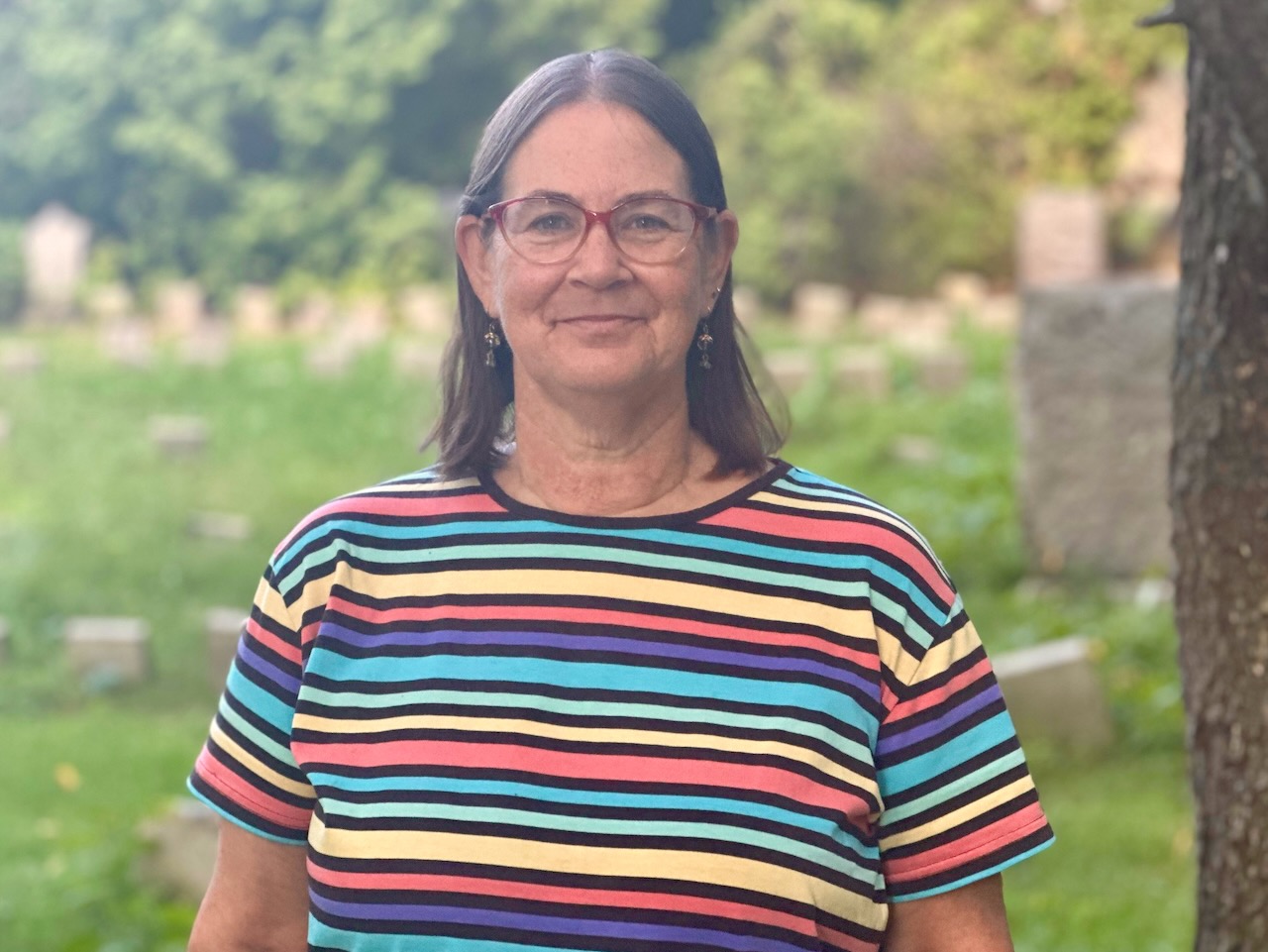
photo by Lara Herscovitch
Thank you for lifting up your work researching and sharing the stories of those buried in Blake Street Cemetery. How did the work begin for you?
During COVID, I started taking photographs of people’s gravestones through this website called Find a Grave. Lots of different people use Find a Grave — family members, professional genealogists, regular genealogists, anyone can search on it. A gravestone or a headstone can provide great information; a photograph is really helpful. I started taking photographs at Fair Haven Union Cemetery, which is in my neighborhood.
I was thinking and wondering about the people in the graves. The cemetery was not in great shape. A number of unhoused people lived in it, and it was being used by sex workers. I was going to write about the cemetery, but they began locking their gates. So I started taking pictures at other cemeteries, and that’s when I found Blake Street.
I was really intrigued because it has tiny headstones only with numbers on them. I knew the concept of a “pauper cemetery” or a “poor section,” but I’d actually never seen one. Something about it also being in a hollow where you go down a hill and there’s tall trees all around it — it just felt like a quiet, separate, sacred space that had been forgotten.
I’m of the idea that cemeteries are beautiful places that we can enjoy, but at the same time, should be preserved and honored. And this space didn’t look very honored because over the years, clearly during windstorms, trees had fallen down and were breaking stones, and it was just very sad looking.
I thought, if I start writing about people here, if I find somebody who can be honored or respected, then maybe people would care more about the cemetery. And so, I started researching people. For over a year now, I’ve been writing up genealogical sketches of them and sharing them online.
How do you decide who to research?
As a genealogist, there are certain people that are easier to research, and people that are really hard. Certain eras are really hard, some eras are really easy. We use census records as a starting point and from there, dig into other research sources.
In the 1930s, this guy in Connecticut — Charles R. Hale — started searching for veterans’ graves in the state. He wanted to have a stone for all veterans that were in Connecticut — not just who served here, but also who were buried here. It turned into a larger project, searching for all cemeteries in Connecticut during the Works Progress Administration under FDR. I don’t think other states have done this, but Connecticut has transcriptions of all headstones found in the 1930s. It’s really an amazing collection.
So if you’re in a cemetery — we’ll just pick Westville Cemetery as an example — you can tell where the project worker walked. You can walk in the cemetery, and see three names: you’re passing Bob on your left, and then Susie right next to him, and then next to her is Barbara. And when you look at the the Hale Collection sheet, you can see Bob, Susie, Barbara.
But you can’t see that at Blake Street, because there are no names on the gravesite markers. Sometimes you can’t even see a number.
I’m thinking, well, how did Charles Hale know who was buried where? That’s one of my challenges. It’s driving me crazy.
What was also unique is he listed people of color. It says “Barbara, colored,”… “Bob, colored.” How would he know? But assuming it’s accurate, he’s like the original genealogy angel — and a huge one at that.
I don’t know where that original data came from, but the Charles R. Hale collection, which you can find online at the CT State Library, is for every single cemetery in Connecticut. Blake Street is 71 pages, with 30 or so people on each page. I wanted to better understand it, so I put it all in an Excel spreadsheet so that I could manipulate it, sort by surname, sort by date of death, sort by this weird, random number that he included which could be the plot number, and I could also sort by people of color.
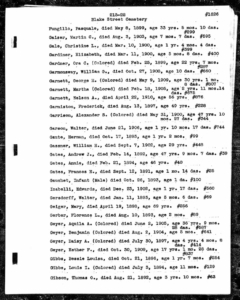
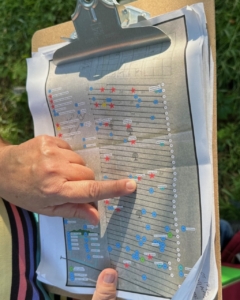
At that point, I decided I would research people of color. I had done a couple of research projects for family and friends that are people of color before then. I thought it would be interesting, it would hone my skills. And — I don’t know if it’s the same for every genealogist — when I start researching somebody, I can become very invested and emotionally involved.
The more research I did, the more I became emotionally involved, caring about each person, and then I thought, I should post it on a blog so that people can find them. There may be family members that are curious about who’s buried there, or, my guess is a lot of New Haveners are descendants of these people. And that’s how my Buried Stories blog came to be.
What do you mean by “genealogy angel?”
When I started out my more serious genealogy research, I needed some information from New Jersey. And back in the olden times when nothing was online, you had bulletin boards — you posted questions like, “I’m looking for so and so, in the New Jersey archives.” And somebody would respond, “I’m going there next week. I can look it up; give me more information?” Then they mailed me this whole photocopied package at their own expense. Most of us are all-volunteer, we just do it because we love the work and discovery of it.
It was very common for genealogists to help each other. Bulletin boards also included things like, “I have this book and I can look this up,” or “I have the CD and I can look at that for you.” It was very common to offer lookups — “I can look this up for you.”
What Find a Grave is all about at its core, is volunteers helping out others who are seeking family and friends. And it is just one of the many web pages that are available and accessible for people that are doing research.
I had been using it for research purposes, but wasn’t a member, didn’t have a login account. Once I created an account, I realized I can take and upload photographs to help people see the images of the gravestones or the headstones of their ancestors.
What is your relationship to cemeteries in general?
Oh, I love cemeteries. I grew up in an age where kids ran around the neighborhood, maybe a quarter mile or a half-a-mile radius. There was a cemetery within my radius, and we would play there. Once we got older, we might have snuck cigarettes there, or just hung out. Now, as an adult, I still visit the cemetery where both my parents’ stones are. It’s very common to visit the cemetery, drop off a shell or a stone, or now my family expects me to also clean gravestones from mud or whatever.
Is cleaning a gravestone an emotional experience for you?
It depends. Where I’ve volunteered — recently in a Jewish cemetery — I just asked the organizer, “What stone do you want me to do?” But doing it for family is different. I do think about them while I’m cleaning their stone.
At Blake Street, the only stones I’ve been cleaning are probably veteran stones. There are a lot of gentlemen who served in the 29th Connecticut Colored Infantry Regiment, and a couple that served in the 54th Massachusetts Volunteer Infantry Regiment, which was also a regiment of Black soldiers. I do reflect on who they are, and what they’ve done to serve the country. Especially right now, in this moment.
I try to clean the stones if I’m writing about them. And I’ll admit I talk to them a little bit, especially if I don’t have time to finish one, I’ll tell them “I’m coming back for you tomorrow, David.” You become connected to folks when you research their lives. It’s silly.
Not at all, it sounds respectful. How did you choose the first person to research at Blake Street?
It started alphabetical, believe it or not, also looking at certain census records. It’s easier if somebody was alive in 1860, 1870, 1880, or 1900, which is like a bonus census record. It helps you confirm who the person is, who their partner might be, if they had any children and maybe even their parents. Then that gives you a lot of ways to prove people are who they are. It’s logic and proof, and you have to have multiple sources to substantiate and support your theories.
So it started with Charles Coe and Daniel Chase, both Cs. Then I tried to skip ahead, and found a woman who was the oldest person in the cemetery — Lois Tritton. I didn’t realize at the time that she’s fairly well known in certain circles in New Haven, and she is the last person in New Haven — and possibly in Connecticut — to be auctioned off as a slave.
I assume you know the Witness Stones project?
Yes; the time period that I research at Blake Street is probably right after the time period they are focused on. The people in Blake Street died sometime between 1884 and 1931. And so many of them might be the first generation after slavery, or, in some cases, they were an enslaved person, depending on their age.
What do you recommend for folks who want to research their family members, who suspect they have ancestors in Blake Street or other unmarked gravesites?
That’s a great question. First, I’ll talk about the writing. Genealogical sketches actually have a traditional format and structure, and I go beyond it a little bit in my blog. But at the same time, the earlier blog entries do follow more of the structure, and they’ll find out because it’s the day and then the month and then the year. People said they found it distracting, so for later entries I changed the way I was writing it.
They’ll also find a lot of sources, and reading sources, that can help someone understand where I found everything — that’s what genealogists do as well. To prove the accuracy of the research, I want you to be able to find the source and see where I get any information.
But if you’re doing your own research, there’s a lot of free web pages out there. I think familyresearch.org is the best one to start. And Find a Grave is also free.
If people think their ancestors are connected to Blake Street, I’m more than willing to help figure out if they are. The proprietor of the Westville Cemetery spoke with a man recently who thought his great-grandmother was at Westville; but the proprietor thought she was at Blake Street. So he gave my information to the man, who told me she had lived in the Almshouse (which was the last one in New Haven that was up on Springside) and died there in I think it was 1907. I found her obituary, found that she was definitely at Blake Street, and then I walked the cemetery, and it was by luck that I found her stone.
They’re coming here in the fall from North Carolina and California, to place a new stone for their great-grandmother. It makes me want to cry, that I can help in that way. It is emotional for me, but I can’t even imagine the degree of emotions involved for the family that had been trying to honor their great-grandmother in this way, but they couldn’t find where she was buried or the location in a cemetery.
Wow, that’s beautiful. I wondered before we started talking if your relationship with the work was with the living or the dead, or both. It feels now like it’s with the living as we heal or connect with our ancestors. Does that feel right?
It does. Learning about our family history helps us understand ourselves a lot better. And it’s not just on a personal level, but it could be in the historical context of things. The time period that I’m researching — just because of the way the years are of the people who were buried there — the Civil War and the Reconstruction period are front and center every day. I’m fascinated by that time period.
What is it about that time that fascinates you?
I think it started with my own ancestor — a traveling bigamist preacher. That was his time period, and I was researching him. It’s a time of huge transition and transformation. Not only for people of African descent finally, finally being freed, but how they make their way in the world. After they get “freedom,” they’re left to their own devices. There are those that survive and those that don’t, and sometimes the reason they don’t survive is because of systemic racism and all the roadblocks.
And you also have Caucasians and new immigrants coming in. How that all mixes together, I just find it all really interesting.
I’m from Massachusetts, Cape Cod — so I’m learning a lot about Connecticut history too — including that Connecticut was the last state in New England to abolish slavery (in 1848). I wondered why, all of a sudden, there’s more free Blacks in 1794 and 1795 in Connecticut. It’s because there was a piece of legislation that passed in 1792 which said, ‘If you free your enslaved person, and they are older than 45 years old, you have to maintain their health and safety for the rest of their lives.’ And so the enslavers started “freeing” them because they didn’t want to have to support them as they aged.
So I’m learning a lot. I don’t always understand the context, not knowing Connecticut and I’m not a history person, just trying to learn. History naturally comes along for the ride, if you’re leaning into this and trying to make sense of it all. Every time I write, I learn something new. And I try to present it in a way so we can all learn together.
What would you say is the core value or values that are showing up for you animating this work?
I guess because of the type of research and analysis, I would say integrity. I seek accuracy.
I’m also hearing contribution?
Yeah, I’m definitely contributing. I can tell you, others have told me that they appreciate that I’m not only contributing information about people from New Haven, but that they are people of color and that we need to hear more of their stories. I’m appreciative that so far it’s being well received.
Is there an equity value in it for you as well? It sounds like you chose Blake Street because it was people who had been neglected and forgotten.
Yeah, most definitely. It’s funny. Equity wouldn’t have been the word, but it is about equity. For me, it is about people that you just don’t hear their stories enough. They’re common folk, like most of us. When we’re doing family history, most of us don’t find out that our great-grandfather was a captain of the army and sailed with Washington or whatever. It’s amazing just to find out if our ancestors were literate or illiterate, how did they make their way in the world, seeing their X marks as a signature on certain documents — that is very moving.
And so, in that way, it’s just telling the story of the everyday person who contributed to the creation of New Haven. We have a guy who was a mason that helped build the second state building on the New Haven Green. Another guy who was a carpenter, and another who was a gardener.
I don’t want to appear that I’m usurping other’s family histories. I’m just trying to use my talents for good. And my talent just happens to be genealogy. Who knew?
When did you first feel drawn to genealogy, and how has it evolved for you?
For forever. Probably since I was about 14 and my grandmother showed me the family Bible, and a family tree that was written in her great-grandmother’s hand. One of the first things I remember doing is copying that family tree, and learning how to read the cursive.
I would say it’s always been a hobby. My grandmother was really keen on saying we were from the Mayflower, but she didn’t know how. Research then, was all by paper. You had to write and correspond to offices, agencies — it wasn’t as clear as it is today. Today, sometimes your tree’s already created by somebody else online. It may not be accurate, but it’s a start.
One of the first things I did when I got a computer in the early ’90s, was invest in family history software, so I could begin assembling the family tree in a logical manner for my own family. I researched my ancestor Edward Dunbar — I became so fascinated by the story of him that my grandmother would tell, so it felt like an honorable thing to do for her. She was very religious, and held an idealized version of him; she thought Reverend Dunbar was amazing. And in my research I discovered he was actually a bigamist; he traveled the country as a preacher and slept with lots of women. (He’s the subject of a historical fiction trilogy I’m writing currently.)
I wrote an article that was published in a national magazine about his story, and that was when I really thought, “Wow, this is so much fun.” Even to the point where if I traveled to another state because of a conference, I would stay two extra days so that I could do research in that state if it happened to be connected to someone I was focused on.
So I would say the last 20 years I have been really focused on genealogy and family history research. In 2018, I went for my genealogy research certificate to hone my skills and build up the areas where I wasn’t strong — deeds and land records.
So, yeah, I am pretty serious about it, many memberships — my hobby is very expensive!
I’ve written up my own family, proved and disproved a lot of family beliefs, published in a couple of genealogy journals. But ultimately, sometimes your own story gets kind of dull and boring.
And I like to help others. I found a group called the Atlantic Black Box — their tag line is “researching and reckoning with New England’s role in colonization & enslavement.” They’re based in Maine, focused on helping New Englanders understand that slavery and enslaved people were not just in the South, but also up North — and bringing that history forward.
At one point, they were looking for volunteers, but the timing didn’t work for me. But it planted the seed — I think all of that was rumbling in my head when I started thinking about where to start researching.
How do you see the field of genealogy interacting with race and written history?
Traditionally, family history and genealogy I’d say has been a way of perpetuating and supporting white colonialism.
When I started at 14, for me it was just the family Bible with all the names in it, and the pen and ink, where you could tell great-great-grandma dipped her pen in ink and then did a cursive of people’s names.
I have done extensive research on my own family. I connect to at least 16 of the Mayflower passengers, all the early arrivers, and yes, the early European colonists that killed Native people. It is easy to be connected to so many, because in the early days there was so much intermarriage because people died — often people had three spouses and eight children or 12 children, because it was all about survival.
I think it’s important to know our own family history, and what it means in a larger historical sense, including the damage that was done to your own family or inflicted on others. I recognize there are many family associations, like the “Mayflower Society,” or any of 100 others — and while I could join them, I just don’t see the value that others see in them. Because there’s so much history beyond that moment in time. We all have so many ancestors — two parents, four grandparents, eight great grandparents, et cetera, et cetera. Your circle goes really wide and big, and you can decide which direction to go in.
I want my research to be about supporting families, learning about your Uncle Joe and how he was a carpenter, and he may have touched every piece of wood in this house or, he might have built something in this city.
And in the process, I get to learn a lot. Not only about the history, but about myself — which we always get when we learn something.
I wondered if learning or curiosity was one of your core values, too.
Learning. Yeah. Yeah, definitely. I will say fanatical. When somebody gives me a challenge? A friend who works at the Beineke Rare Book & Manuscript Library was teasing me the other night. I was at a meeting, and he comes over to me and says: “All I have to say is: John C. Duke.” I say, “John C. Duke, like, D – U – K – E?” He says, “Yeah. A guy in a background.” And I asked him, “What about him?” He goes, “That’s it.”
Oh, my gosh. Well, I took this as a challenge, so of course I’ve got to find out who he is. I’m thinking, ok, what’s the story behind this guy, how does he connect with my research at Blake Street? I spent two hours that night trying, and concluding that I can’t find much about him — but did find a lot about his wife. [laughing]
[laughing] Well, that makes me want to look up the definition of fanatical – I hear it as curiosity, appreciating history, and truth-telling.
Truth-telling — yes, I like that.
What would you say is the biggest challenge in the work for you currently?
I think the biggest thing that I’m struggling with right now is I feel like I don’t have enough time. I love doing this research and writing about it and sometimes I just want more time to devote to it. It’s all-volunteer; I also have a day job.
What’s next for you in the work; do you envision researching everyone in Blake Street cemetery?
Definitely not; there’s thousands of people. I can look at the data and know that about a third of the occupants are children under the age of 10. Impossible to research, really. I would be sitting in the vital statistics office in New Haven for years.
Originally, I began it as a way to increase awareness of abandoned cemeteries in New Haven. My thinking was the more we learn about the people buried here, the more we could see the value to take care of it. There are a few of us looking at starting a Friends-Of type group to support abandoned cemeteries, or cemeteries that have no caretakers.
I definitely want to write more stories. Each story takes me at least a month of research, probably about 40 hours, maybe more. Which is why sometimes I break it into parts, because it’s complicated and I need more time to do the research. I do have thoughts about putting it all into a book. I’m working on my MFA, and even though my thesis was going to be my historical fiction book, it’s possible this could be my thesis. I don’t know. But I do want to have it as a book.
I think Aaron Goode and I will do another tour of Blake Street Cemetery this fall. Last year we highlighted Lois Tritton, the last enslaved woman to be auctioned on the New Haven Green. Next month, on October 26th, I’ll likely cover multiple stories of people buried at Blake Street, including men who served in the 29th CT Colored Regiment.
Learn more about Sherill’s work at her Buried Stories website and via Instagram
Interview with The Circle’s Creative Director & Editor, Lara Herscovitch (Cohort 10). To reach Lara directly: thecircle@clpnewhaven.org or Lara@LaraHerscovitch.com