
contributed photo
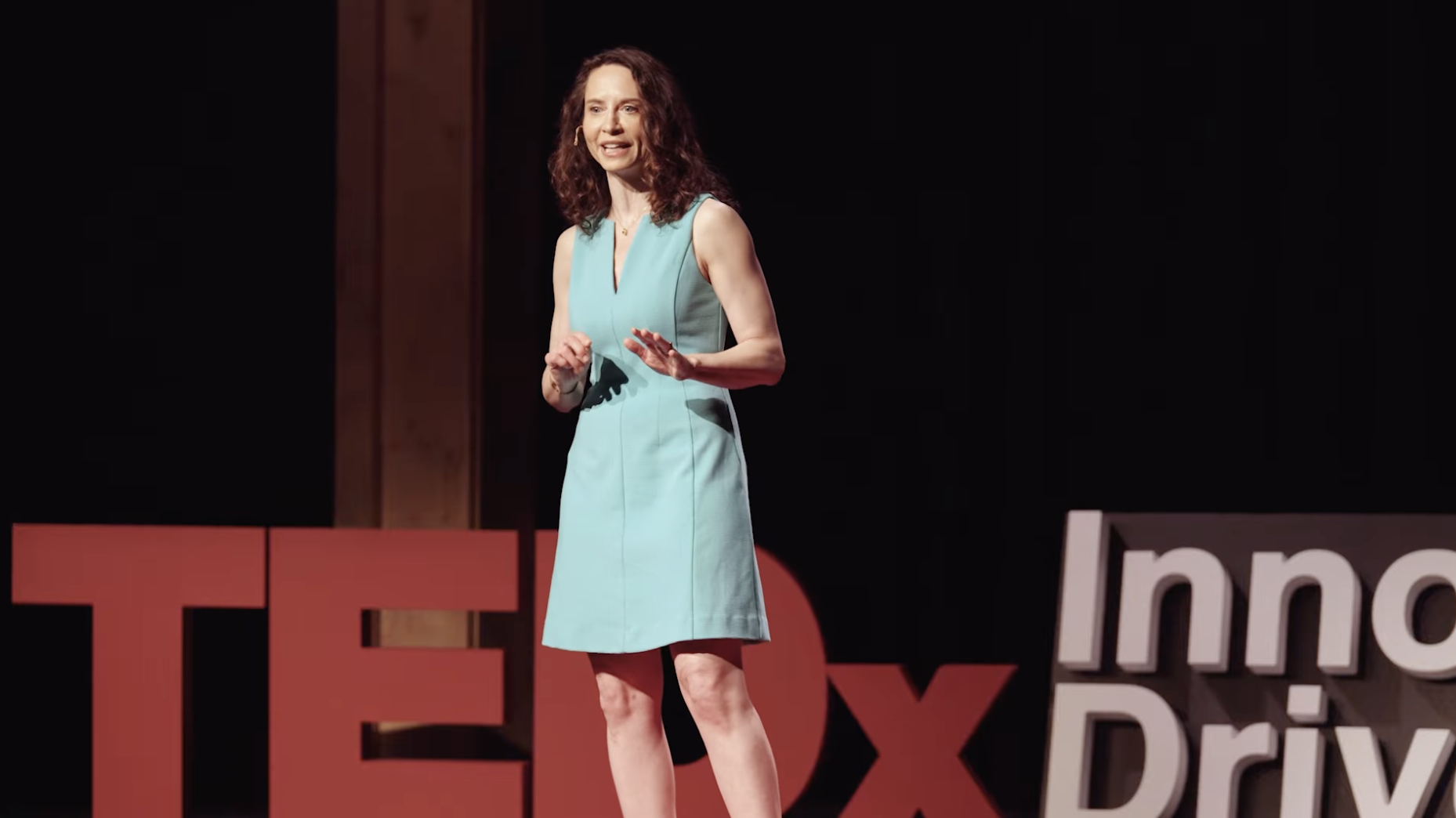
I know our plan was to resume after Part One – Caring for Caregivers – on theme of Caring for Ourselves, but since you just spoke at TEDx : Innovation Drive, let’s start there instead.
Have you spoken at a TEDx before, how did that connection happen?
I had the honor of speaking at TEDx New Haven in the fall of 2025 about the profound importance and impact of family child care. My talk was very personal. I shared my own experiences as a caregiver at a very early age, and how those experiences led me to found All Our Kin.
The talk resonated with a lot of people in the child care community. But it didn’t reach people who weren’t already involved in early childhood education. After that talk, I thought a lot about how to give a talk that would reach people who don’t understand the value of child care.
A few months later, I was invited to speak on a Civic Track panel at the June Innovation Summit at Yale / SOM. There, I met Michael Carter, who was putting together a TEDx talk focused on innovation. He was intrigued by my presentation, and wanted to strategize with me about how to make child care appeal to his audience — innovators and entrepreneurs.
I was thrilled to have the conversation, because it was exactly what I’d been thinking about. How do we cross the bridge from being heard amongst our childcare and nonprofit community to being heard by… everyone else?
In my first TEDx talk, I crossed one bridge — from a normal policy-type talk, to why the work is so personal to me (not unlike the kinds of conversations we have in CLP).
But that wasn’t the bridge he was looking for.
So I offered the idea of — ‘What can K through 12 education learn from child care?’ See, usually we assume that the standard is traditional school-based education, with a call for child care to be more like school. But maybe that’s backwards.
We understand more and more each day that it’s our ability to learn that matters – especially as AI is reshaping what and how we ‘know’ information.
Every day, child care educators nurture in their students: creativity, adaptability, empathy, imagination, curiosity, resilience, and working with others. So, I suggested we center that — and them:
To fully prepare young people for the future, school should be more like child care.
I admit it was a deliberate provocation; I don’t in any way intend to suggest that the best K-12 teachers don’t also do the things I talk about — they absolutely do. But in child care, the approaches I describe in my talk are the standard of practice; every child care educator recognizes their centrality. It’s a different frame for how we think about learning.
He loved it, and we went with it.
And of course, everyone’s thinking about AI, so that’s an easy hook. What does AI mean for human development? It means that we have to focus on the things that make us uniquely human. Child care educators do this better than anyone else. Their work is vitally important, both because of when it happens, and also because of the way they do it.
If we can reposition them as the experts that they are, we will have won. That was the goal.
I found it so helpful, the way you named the fundamental shift in how we think about learning, and the truth of child care educators not just “preparing children for school,” but preparing children for life.
I was so surprised by the whole process — how many “ahas” there were. I was saying to someone as I organized the talk, that educators teach resilience. They asked me, “how they do that?” So I told them, “Ever seen a block tower fall down? And a child rebuild it?” And they got it.
I realized that these very simple stories… were things that people hadn’t talked about, and I could provide a frame that would make sense.
It’s amazing, all the ways we fish can’t see the water, and then we take turns describing it so we can re-see ourselves and the things that matter most.
Absolutely. And, that was maybe the hardest part. I tried to distill down everything educators do to three key points, after starting with ten. All of them about the power of the nurturing, developmentally appropriate learning approaches that child care educators offer.
Then the question became, what are the stories that help people understand that? And the stories are what make it human, what help it make sense. Because I work at All Our Kin, I have lots of stories!
Parents, entrepreneurs, it didn’t matter who — everybody responded to those stories because they’re tangible, joyful, and such human stories. They remind people of things deep in their brains that they connect to. Picking the three themes was the hardest, and picking the stories was the most fun.
I am not a child development expert. I am a lawyer who for 25 years has run a childcare nonprofit. What I have, though, is I have those stories. At first, I struggled with this imposter syndrome — like, who am I to talk about child development? I’m a lawyer on the team. But I can share these stories. And I’ve been really honored by the enthusiastic response of child care educators, who see their work reflected in my speech.
Their stories show them as the complete experts in innovation that they are. But as a society, we ignore them. And in doing so, we are missing out. They don’t have to be more like K-12 teachers. We all should be more like them.
Interview with The Circle’s Creative Director & Editor, Lara Herscovitch (Cohort 10). To reach Lara directly: thecircle@clpnewhaven.org or Lara@LaraHerscovitch.com
Watch Jessica’s TEDx : Innovation Drive talk
Learn more about Jessica at All Our Kin and connect with her on LinkedIn