
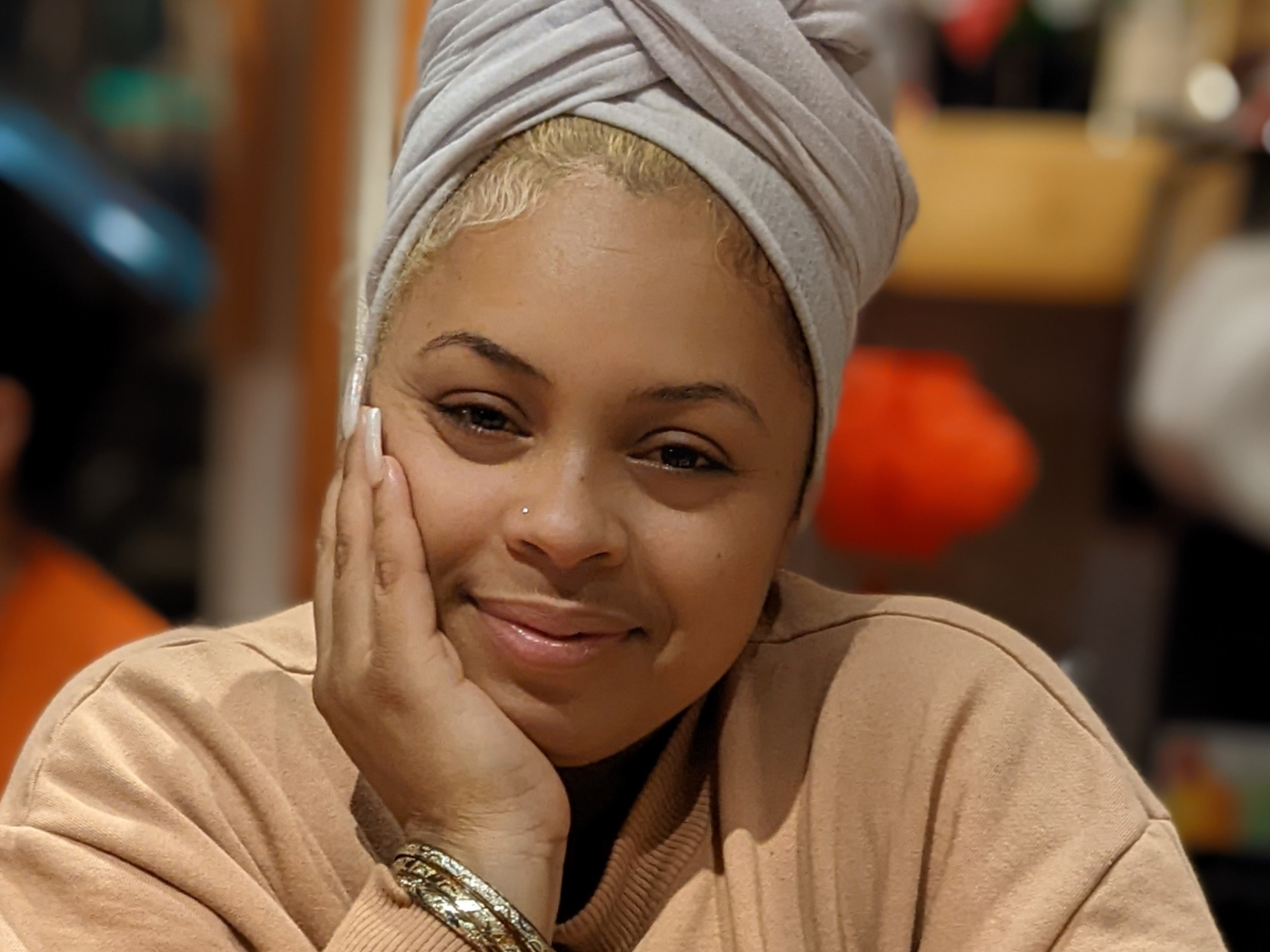
contributed photos
First, congratulations on becoming New Haven Poet laureate!
Thank you! I’m excited about it. It’s a two-year term, so 2026 to 2028.
When we talked last week, you shared that everything in your life right now is “rooted in creativity.” When you think of creativity in your life, how do you define it?
I never thought about defining it, so I appreciate that. I think that’s something that I’m going to do after this call. But when I think about my life being rooted in creativity right now, I think of a really broad stroke.
When I first engaged in the creative space, it was through organic means, just like anyone else. Phylicia Rashad has a great quote about art being the basis of human expression. So we’re always engaging in art, whether we realize it or not. Whether we mean to or not.
Amen.
Since I was a really little girl, I’ve engaged in that organic creativity, and then it moved into performance through poetry, theater and dance.
Then as I got even older, it became very intentional and I started really solidifying my career. It was realistic for me for the first time in my life to pursue a career in the arts after an internship around capacity-building for grassroots arts organizations. That was my first real introduction.
I had already been doing all types of strategic development — in youth, community leadership, and workforce. However, I got my first taste of the administrative side of the art sector during that internship with the Creative Workforce Initiative.
There was something inside of me that said, “Okay, the people-facing work is fun, but how is the art sustained and how do I become a part of that?” Ensuring the arts is sustainable, not just a career, but the entire ecosystem.
So when I say my life is rooted in the arts, it’s because on one side of the coin I am working behind the scenes, doing the back-end work that supports sustainability statewide. And then on the other side, I am a performer. My career is really at a pivotal place where I’m being catalyzed in so many different directions and really good directions, as far as visibility, accessibility and opportunities.
When I say my life is rooted in it, that’s what I mean — both of those sides.
When you say “people-facing” work, do you mean writing individually and performing?
Yeah, like actually performing in front of crowds, or doing workshops — that’s the people-facing work to me. I’ve taught at a lot of high schools and colleges over the years, that’s where I started off at. I first got my first opportunities teaching at Common Ground and Trinity College.
How do you find the toggling between your people-facing work and organizational work; how do you navigate the relationship between those two branches of the tree?
Oh, I think it’s really complimentary — and I actually find it very easy to navigate between the two because they genuinely feed each other. The sustainability component is critical, and being able to witness outcomes serves as tangible evidence. It’s all rooted in creativity.
While working on a year-end appeal for the Arts Council, it was suggested I include a poem in one of the inserts. Normally, I don’t know if that would be a thing, but it’s a thing this year because we have a poet on staff. So it’s a beautiful opportunity and I don’t feel like those two sides conflict at all.
Both aspects allow me to create a bridge because I get to touch all sides and engage all stakeholders. I know the joy of both creating and consuming art, so ensuring its accessibility is a labor of love. It’s truly a symbiotic and mutually fulfilling means of displaying creativity.
When we spoke last year for your interview in The Circle, you described yourself as a healer. Do you feel that role in both types of work in creative spaces?
I love the way you ask questions, because I don’t think that I would ever think about it in that way. And then it inspires me to say, wow, I think that yes, because there is both systems change and individual impact happening.
And the other part is, whether you call yourself an agent of change or a healer, is that you are doing something to actually heal a system that is sick or broken, when you get to make space and then invite people into that space where they are traditionally, historically excluded.
I have only recently received so much feedback around the impact of the work in so many different capacities. I have a poem that is currently viral called “Man vs Bear.” I never imagined having such a widespread impact, but I received messages from women as far as Ireland saying ‘Thank you for this piece. We are experiencing high rates of femicide here. And you just empowered me to have a voice that I hope I can empower my daughter and future generations to have.’
I had no idea I had the ability to touch someone in a completely different continent in that way.
What a powerful example.
Yeah. So only now, I know the impact, like the profound impact. That poem holds such a special place for me, because it’s probably one of my best works. I mean, I love all of the stuff that I do, but in terms of digestibility, it’s something that is fit for audiences. It doesn’t just have to remain in academia or art spaces where people intentionally seek to consume art — anyone can digest this and understand what is being talked about.
It’s so empowering. I was just answering a question that was floating around in the internet in 2024, supported by my history and my first career as an environmental educator. I felt like I was postured to answer it:
Who would women rather be alone in the woods: a man or a bear?
To create a parallel between the behaviors of men and bears, and how society actually teaches women to use the same precautionary measures when they go outside their front door as they teach you when you’re in the wilderness.
Was poetry the first creative art that found you?
Actually, dance is my first medium, and it is the closest to my heart. I started off with the wisdom of Phylicia Rashad; the full quote goes:
Before children talk, they sing, before they walk, they dance, and before they write, they draw. Art is the basis of human expression.
I love that quote because the way I used to experience music was in my body; I was choreographing dances for my two sisters to do all the time when we were young.
How old were you?
I think I was around seven. It was so great. I think my sisters and I still can remember some of the dances!
I love that, the way we know who we are when we’re really young.
Definitely. I started dancing first, and then I started indulging in poetry. My cousin did this really profound poem; this was during the AIDS epidemic, which is what the topic was. It was so inspiring, even though I was so young, I was only eight years old. I had no idea the depth or the impact the AIDS epidemic had at that time. I just knew that the way the poem landed with me, I wanted to do that thing.
I used to go to Fairhaven Middle School. Mia Duff was a history teacher and dance instructor. She just so happened to be holding cheerleader tryouts, and she wanted to see if anyone could do a leg lift. At that time, I wasn’t dancing formally, but I was a very competitive person, I played a lot of sports. So I wanted to see if I could do it.
I did one, and she was like, “fall into a split,” and I fell into a split. I had no idea I had these abilities. And she was like, “Would you like to be the head of my cheerleading squad?” I said, “Absolutely not. I’m an athlete, I don’t cheer for people.” I was super arrogant at this age: “They cheer for me.” She said, “Well, how about ballet?” And I said, “You know what? I’ll try that.” So I got into contemporary and classical ballet, and I did that for almost four years.
I also did theater at the same time with Robert Esposito, at Fairhaven Middle School. There’s a play-turned-movie called Rumors, starring Meryl Streep. I played Meryl Streep’s role. I also did The Wizard of Oz.
So creativity was an ecosystem for me. It wasn’t just one medium or one part of the work, it was all of it, and all of the educators who supported me through it too.
It’s a great example of why we should never cut arts programming.
Exactly. I mean, my God. I had the most profound experiences at such a young age when I didn’t have the language for it. I’ve had full circle moments where Rob would take us on field trips to Long Wharf and the Schubert to see our first plays – Midsummer Night’s Dream and other works — and then I got to perform on those stages as an adult.
Or where Mrs. Duff took us to New York to witness African-American ballet in real time. It was the first time that I ever cried — I think I had to be 11 or so — at a story that was being told without words.
And it was the first time that I experienced representation, where they were full-bodied people on a stage in ballet. Because I was a soloist, and I was always a chubby girl. And I had a woman of color who was not just my dance teacher, she was my first real role model. So there was just so much richness that was rooted in the education that I got in the arts.
That’s beautiful, thank you for sharing. You mentioned that you were “indulging” in poetry – I’m curious why you chose that word?
When my cousin shared that poem with me, I expressed an interest about poetry openly in our household for the first time. I do not come from a house of readers and lovers of literature. I’m the outlier in that aspect, the only. But my mother recognized what I shared. She was a thrifter; she went to Goodwill, and she decided to get me a book of poetry, not knowing what she had picked up. She brought me back a collection of poems by Sylvia Plath.
So this was my introduction to poetry, and it did feel like an indulgence. I was already in a space where I loved literature so much because it was a world that I could escape to and indulge in. And this is what poetry did for me as well.
Ah, got it — I heard it as possibly feeling frivolous, but now it sounds more like honoring or savoring. In your interview in The Circle, in addition to healer, you also described yourself as a culture bearer, storyteller and educator. Do any or all of those roles feel like a main through-line for creativity?
I think it’s a combination of all of those things, right? A part of it is that there’s single narratives that are dangerous and that are historically pushed, especially about certain cultures and communities. And there are individuals within those communities who desire to change that narrative or just widen the perspective through cultural preservation and storytelling.
So when I first started, that’s what the work was rooted in. It was rooted in dismantling these dangerous single narratives by telling the real story from the perspective of the lived experience of a person of culture. Poetry became the vehicle for messages that weren’t normally received well. Especially as a woman of color in a sector and world that makes it near impossible to be both palatable and progressive.
Did it also center on being female, like in “Man vs Bear?”
The bear poem is my lived experience as a woman growing in a very dangerous, patriarchal society that includes rape culture. So, it’s all of the above. My hood mama experience poem reveals or peels back all of the layers of what a mother in the hood — literally — does, or how she shows up. It combats the narrative of how some people can perceive a single mother or where I come from.
So it’s all of those different intersecting identities and layers of who I am that show up in that storytelling and that truth-telling.
I think what goes in hand with that preservation is the history of storytelling. The point of oral preservation especially in relationship with poetry, is that poetry, unlike formal speech, has a rhythmic cadence that causes it to linger in the mind longer. And we are able to pass that on.
The obverse of that is there is a natural radical undertone of making change in spaces, where these narratives are derived from — they go hand-in-hand naturally with each other.
So it’s a combination of all of those things.
I really appreciate you lifting up truth-telling and making change. I wonder if that also connects to religion, being in highly Christian spaces as a person who practices Islam?
Yeah, absolutely. I’ve done pieces that are rooted in that, but also not just that. What I would say is it’s the spiritual, religious identity that I grew up in. For instance, I have a poem about my brother who has been diagnosed with paranoid schizophrenia for almost 20 years. I am his conservator and guardian. When he first experienced psychosis my mother, because of her culture and spiritual beliefs, refused to get him medical care, and instead believed that Vodou would cure him.
So I have a poem about that, the religious nature, the spiritual nature and cultural nuances that are all tied up in the refusal to seek mental health care.
It also feels like how we sometimes write for sense-making — like a type of emotional or spiritual archaeology.
Oh, I like that.
Can you share about your path in creativity after Fairhaven Middle School?
Yeah, so I lost sight of it completely. In high school, you know, I was doing what a lot of kids do, which is like, essentially smelling myself and feeling like I was grown and being rebellious and defying my mother. I just felt all of the things that were cool when I was in middle school weren’t cool to me anymore.
I used to be in the talented and gifted program and that just wasn’t cool anymore suddenly. All of the other extracurriculars weren’t cool either and before you knew it, the summer between sophomore year and junior year, I got pregnant. I had my daughter senior year, and graduated with a one-year-old and another one on the way.
I graduated at 17, and my focus shifted into motherhood, in overdrive. I completely and — not intentionally like, ‘oh, I don’t have this passion anymore or this passion is not achievable’ — just completely was consumed in motherhood, which I absolutely love. I just lost sight of it.
And then when I became a little older and it was time to really pick a career around 19 years old, the arts didn’t seem feasible. It just wasn’t realistic, was the narrative that I constantly heard — and I admittedly didn’t dig deep, it was surface-level.
My relationship with understanding the arts was the ‘starving artist’ narrative. Like you have to have privilege to really get up there, and it just wasn’t realistic. So I was just like, ‘I’m going to live a normal life.’ I left home, and was in a really nasty, abusive relationship, and the person did not give me the space and silence that is required to create. I kind of worked it out of my system, to oblige this person — I felt like I lost the muscle.
I relocated to Virginia and came home in 2017, eight years later when I was 27. I thought what I was experiencing was writer’s block, for all that time. I became an AmeriCorps member through Public Allies, and all of the things aligned at the same time — it was reignited. All of these parts of my identity exploded into professions.
I was inspired by some really amazing writers, some of the best that I had seen in person in a very long time. I started writing again, and I realized, because of the depth of what I wrote, that it wasn’t writer’s block at all. I don’t believe in writer’s block anymore. I actually believe that we just cycle through seasons as creatives, and a part of those seasons is that dormant season that requires you just to consume everything around you and experience and absorb.
I’d been absorbing for those eight years, and it allowed me to create such amazing content.
So after writing and feeling good about that, I was again just trying to blow steam, so I was seeking open mics as an individual, a hobbyist. And that kind of just took on a life of its own. I happened to always be in the right place at the right time, and I don’t think of it as a coincidence. Like, I’m not sure if you’ve ever read The Alchemist?
I actually read it once a year!
So I love The Alchemist so much — one of my favorite books. He says when you pursue your life’s legacy, the universe conspires on your behalf. And I believe that the universe was conspiring on my behalf to bring me back where I always was supposed to be. The Nuyorican Poets Cafe was the first spot that I went to. I didn’t get to touch the stage that initial visit, but I met a Grammy award-winning artist who started offering me opportunities. And then it took on a life of its own.
At Solar Youth, my placement during my time as a Public Ally, they wanted me to run a creative writing program, and I was paired with a fellow who was an assistant dean at Yale, but also a rapper. He’s now one of my best friends. He linked me with a jazz composer from Michigan State who asked me to be on his album. And then before you knew it, it was opportunity after opportunity being offered to me.
That’s beautiful. Sometimes I feel like we spend our lives becoming who we are, and sometimes learning how to get out of our own way. That question of learning how to surrender or allow, but also not tip into passivity — how much to drive and how much to be a passenger, you know?
Yes, I love that.
When we talked in 2024 for your interview, you said your number one top core value is Consideration, and that you see it as overarching and including love and compassion, inclusivity and community. Is it the same now?
Yeah, I think it will always be my foremost value. For the community that I serve, but also for myself, because I get to take that and spread it.
I recently facilitated a wellness retreat with an organization that I consult for rooted in helping the staff humanize each other. Someone talked about pouring into other people’s cups, and I shared at the closing that I don’t believe in pouring into other people’s cups. At first, it sounds selfish. But I believe that if I continuously pour into my cup, my overflow will benefit anyone in proximity to me.
So that’s what I believe about that relationship between where my life is rooted at and how it’s mutually beneficial for me and those that I serve.
And that comes back to the theme of individual artistry being of service — lifting ourselves and each other up.
Exactly.
You mentioned Phylicia Rashad’s quote that art is essential — do you want to share more about that?
I don’t really know how to frame it, because I think it’s multi-dimensional – like, how is art or what is art… and how do I serve as a steward? Aside from it being this personal experience that I get to share with people in different capacities, whether that is bringing people to the table, and ensuring sustainability of the arts, is that when you dive deeper into that sustainability, like outside of the actual creative process, it all requires creativity.
I think that people don’t realize the rate that they consume art at. And they don’t realize how art is literally embedded into every aspect of our lives. From architectural design, to media; because it’s so readily available, it’s so easily consumable. People don’t even recognize how much work goes into it and thus, that it deserves financial sustainability and should be invested in.
For causes that are really near and dear to you, art should absolutely be one of those. You know, something that you said at the beginning of the conversation is that art is always at the risk of being cut, right? Access to it is foundational for not just children, but for all of us. And it is especially a reality right now with the current political landscape and funding environment — the arts are the first to be cut and to be scrutinized. People focus on basic needs, but when we think about our hierarchy of needs, art is definitely high up there.
Interview with The Circle’s Creative Director & Editor, Lara Herscovitch (Cohort 10). To reach Lara directly: thecircle@clpnewhaven.org or Lara@LaraHerscovitch.com
Learn more about Yex at The Word and the New Haven Arts Council