
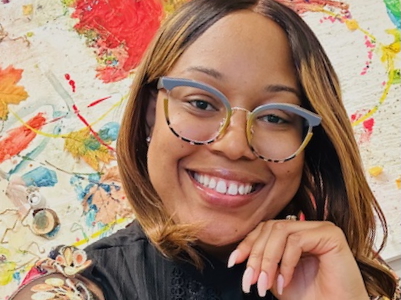
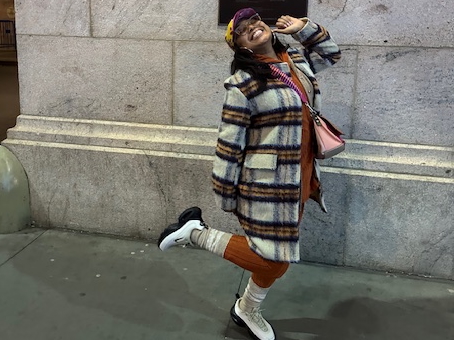
contributed photos
One of the exercises in CLP is about identifying and clarifying our personal values. In Cohort 10, we wrote one value on each of five index cards. Then we had to set one aside, and another… until we were left holding the card with our number one, top core value. Did you do that exercise in Cohort 21?
I remember it vividly. We didn’t write them ourselves, we had to connect with people and end up with our five.
Same concept, but we got to pick cards with different colors and with different words, and move around to meet with people and find our values by connecting through conversations. We exchanged cards with others until we believed we had our final cards. Yeah, that was pretty dope.
I love that adaptation. If we did that exercise right now, and you had your top five then narrowed down to your number one — what do you think it would be and why?
Well, I thought you’d give me the option to name all five, that’s easy. [laughing] I’ll talk it through it and let’s see where it lands.
Integrity would definitely be the first in the sense of how I maneuver and how my character shows up, no matter what space that I’m in. Having a consistent foundation, and my interactions with people. Integrity means a lot to me. And integrity and loyalty are somewhat synonymous to me. One of my favorite phrases is that loyalty is revealed when people have options.
But you know what my biggest value is, actually? It’s all-encompassing. It would be communication, with a subset of listening.
I value communication and listening specifically. I believe that it’s a gift of mine. I had to really process — through the years — what listening is, and the art of it, the gift of it, and the heaviness of it. Because when you listen to everything — verbal, non-verbal pace, tone. When you’re really listening and you’re holding space, it can be too much sometimes. So, for me, it’s learning what to do with that, and understanding why God gifted me with the ability to listen so deeply.
So my biggest value is definitely communication, and focusing on listening to others, and those who hold space to really listen to me.
Because of how deeply I listen, it’s always interesting to connect with people and discern listening to advocate versus listening to understand, and listening to all the things. It’s also why I’m so grateful for the CLP experience; it magnified and put terms to my experiences with communication and listening. Personally, professionally, spiritually, listening dwells in every aspect of my life. Yeah, that’s where I land.
You mentioned that sometimes it can be too much?
Yes, it definitely can be. I have learned over time, because I do hold space and deeply listen, that in a conversation, whether people consciously or subconsciously know it, I’m often the person that is sitting there listening, right? And because I am listening, people tend to share with me on multiple different levels. I don’t know if it’s an energy thing or whatever they pick up on, they often don’t share surface-level stuff. So it becomes heavy sometimes.
Conversations could start really light and really cute, but it gets heavy or deeper often. I remember maybe three, four years ago now, someone called me with some very intense thoughts and experiences, because we have a great rapport and they felt safe enough to share with me.
I’m a spiritual believer, I remember going to God to say, ‘God, what is this gift that you’ve given me and why am I in the position where I could listen to everyone, but I don’t feel that anyone listens to me the way that I listen to others? And what am I to do when people share with me their heaviness?’
I heard you name listening to others, others listening to you, you listening to God, I’m wondering how you think about you listening to you?
That is a phenomenal question and I know it goes back to a big shift in my life. I remember that I was 27 years old, and I did everything around people telling me what I was supposed to be or supposed to become. Yet, I didn’t really know what I wanted to do or how to be happy.
For example, I became a homeowner by the age of 28, and obtained a master’s degree. I was doing all the things, successful in career, and then I’m sitting there like, “Have you ever really listened to yourself, what do you actually like to do? Are you actually happy to be really faithful in ministry and career…” and all of it — blah, blah, blah, blah, blah.
I could say in the past seven-plus years, I really developed a trust in myself in the sense of listening to myself physically, spiritually, and emotionally, being able to be introspective and name: “Hey, there’s something off here.” I’ve really, really learned to appreciate being introspective. So thank you for framing that question.
I’m actually on a continuous journey. And now, I’m confident in where I am with the ability to listen to myself, to the sense where I don’t mind sitting in silence with my thoughts. Sometimes, I just need to sit and ask myself the tough questions and really understand who, when and why, and how some things are impacting me. Or maybe I don’t want to be in some of the rooms I navigate, maybe I feel tolerated but I don’t feel celebrated. Now what?
Like, you know, just growing the ability to listen and know when it’s my voice and it’s not so convoluted by what’s around me — the things, people, circumstances, spirituality, and all that. Honoring my core values and lived experiences is something that I developed over time and only magnified in the past seven-plus years, to the point where I can fully trust and feel confident in and lean into my voice and listen to me and what matters.
It’s so challenging, showing up in service, in contribution, and practicing enough self-awareness, self-care, self- love to fill the well and not just give away all the water.
Hello. [laughing] That’s why I said it’s an ongoing process and it’s something that’s easier said than done.
One thing that I learned and I’m working through is an understanding that whatever gifts, talents, lessons, beliefs, or even skills that allowed you to get to one level in life may not always be the things that you’ll use to get to the next level.
That’s been brought to me in a way that was a challenge and something I was a little resistant to. Yet, due to some of the things that we’re talking about, it’s like, “Hey, you reached a great level in life that you may be successful to others, yet that next level of success or circumstances — what’s that look like, for happiness or joy? And, you know, certain habits or talents or whatever it took to get to C, may not be what it takes for you to get to D. And then EFGH, as you continue to grow in life.
Sometimes it’s dismantling and unraveling some beliefs that I’ve truly coveted or mastered, and it’s like — whoa, I got to undo that or learn something different, or more?
I appreciate you naming “next level” and happiness and joy. Do you mean that ‘next level’ for you is following the internal definitions of success versus cultural, external ones?
Yes. That’s a large part of the business that I started and the leadership journey that I’ve been on — really understanding success, even the term. One of the biggest things when it comes to the business in general — is redefining success on your own terms.
It ties back to what I was saying earlier, that I reached this point at 28 — accomplishing all these things, right? Yet I wasn’t happy or fulfilled. Life changed drastically when I lost someone really close to me, and then grief started to happen, and continues. All the “accomplishments” didn’t hold very much weight. The journey of discovering what is joy in the absence of the things? What is peace in absence of the things? What is success to me?
Finding a pace and steady rhythm of life. Appreciating my ability to travel, as a way of honoring my sister in her absence — she loved to travel, and now I do too. Travel really exposes me to different cultures, different places — and it continues to teach me to have a grace for myself and others that movement doesn’t have to always be so fast. That fast pace, instant gratifying kind of flow does not have to be the way. Like, are you successful because by 35, you achieved A, B and C and D, but then internally you are distraught, dismantled, and unhappy, or you’re not even a nice person, ’cause your character is terrible? No, thank you, I’ll choose a pace and rhythm that works for me and my journey!
I have leaned into the privilege of moving to my own beat and listening to what aligns with my core. What can I do today? What do I feel right now? How can I take a step? Or how can I rest? It’s such a wild dichotomy of things when it comes to this thing called life.
Thank you for sharing. And I want to just pause and say, I’m so sorry for your loss.
Thank you for that.
You may have already answered part of this already; what is one big burning leadership question you’re wrestling with these days?
When you ask that question, it immediately brought me to this space that I’m in life. Words, behaviors, and actions have to align for me to stay, to grow, or to align with any person, place or thing. What you say, what you do, who you show yourself to be!
Amen.
And so yes, words, actions and behaviors. This is how I view them. An action is your immediate response, behavior is what actually happens repeatedly over time, and words of course — what is said. Someone can respond or do an immediate action, but what’s the actual behavior or the culture/character? So what you say versus what you do, versus what actually happens over time — alignment in those three things in leadership reflects true authenticity.
In order for your words and your actions and your behaviors to align as an organization and as a leader, there’s going to be some messiness in the process. So, the question that I am working on within myself, as well as exploring and observing is, what does authentic leadership look like when words, actions, and behaviors align?
It reminds me of what you were saying about integrity — in this case, is the organization in integrity, in a healthy place?
Yes. And psychological safety, right? That’s another thing in itself. It’s why I continue to make the decision to shift pathways on my leadership journey. I’m in the position of my life that I’m not just going to do the things that I do because I’m good at them. It really has to matter to me.
For me, it ties into that core value of listening. Because if I’m listening, and paying attention at so many different levels, depending on where I am in the organization, there’s a responsibility. Am I listening to the words, actions, and behaviors of the organization, or the people that work with me or around me, or within? Am I paying attention.
And then do you have integrity in that, right? You have to really be paying attention to see if things are being listened to at all levels. Are you seeing the impact of your actions, words, and behaviors — are you also listening to that? Are you listening to yourself as the leader? Are you living your truth, living in integrity, are you being loyal to yourself? Are you being loyal to those you’re serving? That all fits together.
I respect that clarity, and the distinction between words, short-term actions, and behavior over time that creates culture. Speaking of which — in this extraordinarily challenging moment, what inspires you, gives you hope?
Essentially, I’m in a season of finding out how to stay inspired. What does that look like day to day, when I’m not hopeful or inspired to do anything? I don’t know if I have an answer.
It’s so hard right now. I respect anyone naming it, so others can feel less alone in those feelings. And, I hear so much energy and enthusiasm for learning and growing and believing in what you’re doing. It lands for me as a both-and, not an either-or. You reflected earlier on your faith; does that offer hope for you?
That’s a good question. I’d like to say you’re really flushing it out, and you’re listening on many different levels and your ability to frame it in a way that really resonates, and I really appreciate that.
I wasn’t raised in formal religion, and I carry genuine curiosity and interest about it; I wonder if maybe it’s so obvious there aren’t words for it — it ‘just is,’ like the fish who doesn’t talk about the water. But let me ask it as a specific question — does your faith practice inspire you, does spirituality bring you hope?
Absolutely. Hands down.
Thank you for that framing. God has always been in my life, though I also went through a season where I wondered why I believe what I believe, and why I was so faithful or religious.
Being religious meant a lot of rules, and going to church on Sunday and Wednesday. For me, there was always the continued unmerited favor and grace. So even as I was unsure about religion and the rules, I also rested in what God is in my life. That allowed me to grow, knowing that no matter what I did, no matter what rules or regulations are followed, God still loves me.
Religion has made me feel like I must follow certain rules to be in God’s graces and to go to heaven and all those things. As I have matured, that’s not actually it; what matters is my relationship, that’s what it is all about. I know that God has always been in my life, and it helps me to believe when I pray, even though sometimes I question. If I wonder, does God hear me? Something will happen that speaks to my thoughts and prayer. And I’m like, “Oh, you are real.”
It’s all about growing into a relationship, and moving away from organized religion. I still fellowship every Sunday, and I still go to church every Wednesday. I have a different mindset — that I’m not doing it because it’s the right thing to be doing, or it’s what I’m supposed to do. I’m doing it because I want to learn more and grow more, be better, be different as I desire to evolve and grow into the best version of me.
It brings me back to what you were saying about listening, and being who you are away from what your external environment is telling you you “should” be.
I love that you just said that — that has been my journey this year. Because I literally walked away from what most people would consider stability, and I was so sad, even though it was right to walk away, even without a real plan. Choosing to go on a journey of discovery and intention so I can thrive and align myself with what fulfillment could and will look like for me.
It was like, so what is my plan? And wait a minute; who am I? What do I want to be? I am starting over — yet not from the beginning, this time from lived experience.
We’ve been reflecting along the way about how this work of transformational change is hard. Stepping in, stepping up, over time, can be depleting sometimes. In addition to your faith practices, how do you recharge, restore, take care of yourself, rekindle your fire?
My first answer is going to be that I had to go through something to learn how to rest. I didn’t understand what was going on with my body. It was like, “Oh, this is forcing me to rest.”
So I’m getting rest now and finding that it helps me to recharge, and I’ve been working on that when it comes to identity, and not diving back in to do all the things that were depleting me in the first place. I am no longer resistant to rest. And it took me literally years to embrace this concept and what rest looks like.
It’s praying. And dancing. I call myself a “Ja-fake-in” — like a fake Jamaican. [laughing] ‘Cause I love it all — the beats, drums, rhythms — calypso, reggae, soca and the dancing, all those movements of the hips and the body. And line dancing!
I also love to sing along — I always just sing. Any music that speaks to my soul or has some really dope lyircs, I’m most certainly singing it. It could be new or current — not too much lol — it could be music where I don’t even know what they’re saying as it’s in another language, and I’m still singing along, maybe humming too lol. I like to sing a lot.
Please introduce us to someone you are or were close with — family, teacher, friend, mentor — who shaped you and how you view leadership and possibility for a better community and world?
Deborah Stanley-McAulay. I don’t even know if this wonderful woman knows she impacted me in this way. She came into my grad school classes, I want to say for communication, between 2015 and 2017. It was my master’s program in leadership.
Two words transformed my life: “Be clear.”
Everything that she said after that confirmed — it matters to be clear. It goes back to all the things in a way of what we’ve been talking about today — in order for you to know who you are, communicate effectively, or even navigate in integrity, there’s a level of clarity that one must have, whether it’s of oneself or others. Just be clear. Simple words and a dynamic concept to actually put in practice to create a lasting impact.
I don’t remember everything she said during that class. Yet when she said it — right when she walked in the room — there was her confidence in how she said it, and her conviction while she was presenting, all of it would stick with me almost a decade later in life. I made a vow to myself as I continue to grow and elevate in my leadership, to lean into clarity.
What do you recommend to us, in each of these categories:
- Reading – Dr. Dharius Daniels’ Relational Intelligence
- Listening – Jorja Smith, “The Greatest Gift”
- Eating – Comfort food. For me, it’s pasta. Red sauce, yellow and red peppers, garlic, onions, beef sausage, ground turkey meat, and pappardelle noodles.
- Watching – Mr. Malcolm’s List – a witty rom com movie on Netflix
- Laughing – Laugh at yourself sometimes, it makes a difference.
- Wildcard – your choice – Dance until your heart’s content.
Learn more about Tiffany via her website, YouTube, LinkedIn
Get in touch with Tiffany directly: info@eloquentingenuity.com