
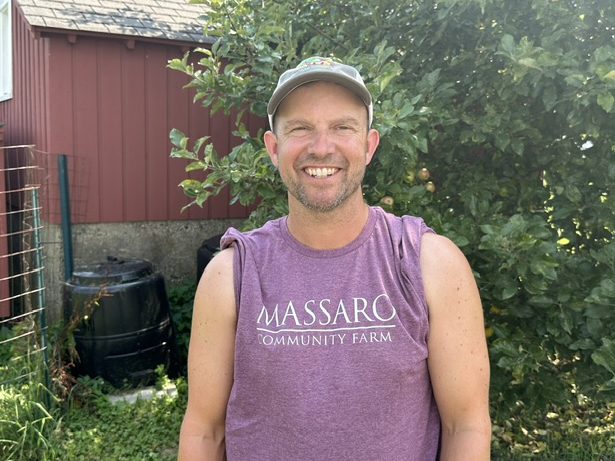
photo by Lara Herscovitch
Thank you again for taking the time, especially in the heart of vegetable farming season. Knowing that most of us don’t farm full time — what kinds of things do you do, as the director of a community farm?
There are so many things, which is one of the reasons I love this work.
I get to be involved in the planting, care and harvest of the crops, the hand-work and equipment operation, all of which directly affects the quality of the soil, which is central.
All the people. I get to know our CSA members — currently around 300 individuals and families. The chefs who buy their produce here, and the folks at our partner agencies like CitySeed.
On an administrative or organizational level, I’m involved in our communications, grant writing, financial management. Really, anything can happen on a given day at the farm, and we need to continually work to find the right balance in what we do for our agricultural and financial sustainability.
And I’d say that one of my favorite things being here over the years has been watching the growth of our team of farmers and educators, who have really taken the farm to a new level. I find myself feeling so grateful and inspired by my fellow farmers, especially the younger farmers here at Massaro, who continue to push us to do better, and to ensure that we are meeting the needs of our community and that our values are reflected in our work.
What should we know about the importance of preserving and protecting farmland and farms?
Simply put, preserving and protecting farms translates into security and survival for our communities. In the U.S., about 80% of the population lives in urban areas, and everyone who lives there is dependent on rural areas to provide most of their food.
This is a huge change. In 1850, over 60% of the total population in this country were farmers. Fifty years later in 1900, 30% were. Today it’s down to only 2%.
And it’s a tough road for those who do farm. We know from years of Ag Census data that most farms report a net financial loss each year, and most farmers rely on off-farm income to get by. Running a farm or working on a farm comes with unique challenges, but when you add on systemic issues like finding affordable health care, child care or saving for retirement, you begin to get a glimpse at why so few people do this work now.
Then there’s climate change, extreme weather events, and the uncertainty of production and sales each year. Farming requires flexibility, patience, resilience, and community support. I think we’ve shown some of those qualities; it’s why I’m so grateful to be here at Massaro.
Last time we talked, you used the term “truly sustainable agriculture.” Can you share more about what that means?
Unfortunately, words like “natural” and “sustainable” are often co-opted, and are used to describe things that maybe aren’t natural or sustainable at all.
What I meant is that a truly sustainable agriculture protects the health and well-being of people, the environment and all its inhabitants. It is organic and regenerative, it works with living ecological systems. It increases biodiversity, enriches soil, improves watersheds, protects and preserves ecosystems.
The practices are productive and regenerative, not productive and extractive. It’s rooted in fairness and care with how we use the shared environment, and creates opportunities for all to thrive.
Of course, these ideas and practices of truly sustainable agriculture are not new; we witness and learn from the practices used by indigenous farmers around the globe throughout our history.
I’ve been so moved and inspired recently, listening to Robin Wall Kimmerer‘s book Braiding Sweetgrass. I imagine the field is facing the question of indigenous wisdom and practice meeting modern technology that can help or hurt, depending on what it is and how it’s used?
I love that book! Yes, one of the pioneers of modern regenerative agriculture in this country I should mention is Dr. George Washington Carver, who in the early 1900s through his work at Tuskegee University, urged farmers to improve and regenerate the soil using practices like crop rotation instead of monocultures, planting legumes to fix nitrogen, and much more.
Our practices today draw from both centuries of indigenous practices, and from more recent scientific and applied research being done by the global communities working in agroecology, holistic land management, and agroforestry.
Generally, we want healthy soil, to grow healthy plants, to support healthy people and healthy ecosystems — so caring for the soil is a good starting point. But, plants can also drive soil health — so we can care for and improve the soil by growing a diversity of plants.
How does regenerative agriculture help address climate change and climate resilience?
Since we are talking about the soil, let’s start there.
Regenerative, organic agriculture focuses on creating healthy soil biology. By growing a diversity of crops and cover crops, we feed the fungi, bacteria and invertebrates living in the soil. This life in the soil, together with the photosynthesis done by the plants, sequester carbon from the atmosphere and build organic matter in the soil.
Sequestering the carbon is key, because it is the carbon dioxide in the atmosphere from greenhouse gas emissions that is the main driver of climate change. And increasing organic matter is critical, in two ways. First, it increases the ability of the soil to absorb and retain moisture, which helps during times of drought. And, it protects soil when there are severe storms by preventing erosion.
Keeping the soil covered, limiting soil disturbance with reduced tillage, and growing a diversity of crops are some of the basic principles and practices of regenerative organic agriculture. This protects and enriches the above- and below-ground biology; it creates and sustains pollinator and wildlife habitat rather than destroying it. And, it uses less water and less fossil fuel, compared with conventional practices.
These are the agricultural practices that need to be more widely implemented to help slow and reverse the current trend of global average temperature increase, so that we can hopefully avoid the worst consequences of climate change.
What do you recommend to us non-farmers, to help steer our lives and ecosystems in a healthier direction?
Well, in terms of what we are eating, I always start with the questions — do you know where the ingredients for your next meal are coming from, do you know who is growing it, where and how it is grown?
Wherever you live, there is probably an opportunity to get to know and support your local growers and food purveyors. That could include joining a CSA, shopping at the farmer’s market or local store, supporting farm education programs, protecting land for farming or forests, or encouraging the use of organic management practices on existing land.
I’m aware of how deep the connection is between migrant laborers and the food system in the U.S… How has ICE been targeting farm workers, including school-age children?
This administration initially talked about ICE only going after “the worst of criminals” for deportations. But immediately after coming into office they started going after farm workers, including here in the Northeast. In response, NOFA’s Interstate Council, issued a Statement last year demanding the release of those who had been detained, and calling for:
“…an end to the attacks on the caring, hard-working people who come to our country seeking to provide a better life for their families… There would not be food on our tables in this country without their labor.
The farmworkers who come to this country make enormous sacrifices, separating from their families for long stretches, missing important family milestones, even sickness and death, to contribute to the US food system. Non-citizens contributed $96.7 billion in taxes in the United States in 2022 and paid higher state and local tax rates than the top 1% of households in the vast majority of states, according to a study published in August by the Institute on Taxation and Economic Policy... A full one-third of this money went towards programs that exclude them from benefits because of their citizenship status. …we stand for respect for the humanity and dignity of all human beings and demand that the arrested farmworkers be set free.”
That brings us back to what you said in our last conversation, that a regenerative farming model includes ecological, social and economic justice.
Yes. Farmland cannot thrive if the caretakers do not thrive; it cannot be made sustainable by a dwindling population of economically depressed farmers and migrant workers.
The unfortunate reality is that the current food system in this country depends on exploiting land and labor; people and environment. A true regenerative, organic agriculture works for systemic change, increasing access to land and nutritious food for all, while building and sustaining communities for future generations.
We absolutely can do this. We can grow and produce without exploiting others. We can reduce waste, reduce emissions and eliminate hunger. We can grow in ways that promote food, fiber, and energy self-sufficiency.
Amen. We’ve covered a lot of ground — one more unintended farming pun. Is there anything else I didn’t ask, or that you’d like to add?
Maybe I can share something from Bill Duesing, one of my first farming mentors here in Connecticut, and founder of CT NOFA. He wrote a book of essays called Living on the Earth. One of my favorite passages is in “The Reasons to Garden:”
“Doing more for ourselves and our community is consistent with what, more and more each day, seems like our only hope: to withdraw money and power as smoothly and quickly as possible from Washington and Wall Street, to shrink the political and financial bureaucracies which have ballooned to fill the space between us and the real world.
Get your hands into the soil this weekend. Plant some seeds for your health, pleasure and sanity.”
The idea that really resonates with me is: Doing more for each other, doing more for our community. This is the kind of message and spirit I think we need in the world right now.
Interview with The Circle’s Creative Director & Editor, Lara Herscovitch (Cohort 10). (Read Part 1 of the conversation here.) To reach Lara directly: thecircle@clpnewhaven.org or Lara@LaraHerscovitch.com
Learn more about Massaro Community Farm, the Northeast Organic Farming Association, the Northeast Organic Farming Association of Connecticut, the New Connecticut Farmer Alliance, and CitySeed
Connect with Steve directly at Facebook or steve@massarofarmcsa.org