
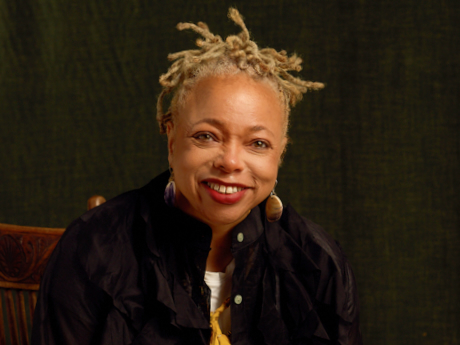
photo by Mistina Hanscom
Thank you for taking the time to talk today. I’m thinking about all the ways we humans can find our way to being who we are through the creative arts. What was — or is — that journey like for you?
Well, my artwork has been… a discovery for me over time.
I graduated from Cooper Union College in 1992, and I got my MFA degree at Bard College–International Center of Photography in 2014. Photography is the thing that moves me; I document my native culture. I identify as Afro-Indigenous. My mother is Cherokee and African American and my father is Mohawk and African American.
When I first started shooting, I was doing it from this place of documentary, and I got deemed a National Geographic photographer in my MFA class — which was not a good thing for me.
The images were great. But it really didn’t speak to who I was as an individual, because photography-as-documentary is — you’re documenting this moment. My class asked me to think deeper, go deeper.
I shoot at powwows and Native American ceremonies, and I had to figure out, why am I doing that? What makes me different than someone else?
This guy comes up to me at a powwow, has the same camera as I do, same lens. He stands next to me, and in that moment, I realized he was there for a different reason.
And why am I there? I’m there to dance. I’m there to connect with the Creator. I’m there to have my family, be in communion with our people, talk about language, talk about water, talk about a connection with the creator and the earth.
What does that look like? What does it look like for our ancestors to walk with us? What does it look like for us to believe that we’re Star People?
I started slowing down my shutter speed and playing with my aperture, and I started creating long exposed images that allowed for movement and blur, and multiple moments of time to be captured in a longer period, in that long second or two.
What came from those images is what I now call spirit photography.
It is in that journey — of coming to that place, of looking at that work, that I found my calling — to not just be a photographer, but be someone that documents this belief that something else is walking with us on Earth. We can’t see our loved ones once they die, but I believe we can.
And in the photography that I’ve created, I’ve been able to share with people, ancestors that walk with the dancers — that walk with us while we’re in those spiritual ceremonies. In and out of the circle.
I had a life-death experience, and this work speaks to that experience. It was whimsical and beautiful, no pain, just this pure beauty. And the images that I create often feel that way, like these whimsy colors, and this motion, but you also can make out a person. And sometimes you can make out something other. Sometimes there’s rabbits in a photo. Sometimes there’s fire, but it doesn’t necessarily look like that to everyone. It’s different for everyone that approaches those images.
I believe I’m a vessel, that I’ve been afforded this privilege to document people in this way. Some tribal nations believed that the camera stole our souls. And some still believe that today. But what I’m doing is not that, I feel like I’m not stealing souls; I’m sharing what our ancestors and spirits look like to the people of today, to remind us of who we are, the seen and unseen realm. Because so many of us are far removed from our religious practices or spiritual practices; the work that I create speaks to how we’re not alone.
Even though we think we’re alone, we’re not at all. That smell that reminds you of a loved one that’s passed on? That is that person, that ancestor, that energy coming to you and saying, ‘Hey, hi, how are you doing, I hope you’re okay. Remember me?’
And you’re building that bridge through photography.
Right; I’ve been able to do it in photography. So without fine art photography, without the arts, I would not have been able to discover that in that way.
The arts is a way for us to really, really, really — and our spirit, and our soul — express what is around us, to see it from our own individual practice, that makes us uniquely who we are.
We gather all this information — seeking information to create something new, or something different, or to bring something back for reminding people, or for reminding ourselves, of something lost or forgotten.
When we walk on this plane, we’re energy, we’re spirit, we’re life. We’re a life force that lives on multiple dimensions, and we can’t always see all of them. But yet, a cell phone text message can go through the air and we can not see it. So why can’t we believe that our loved ones that have passed are in that same room as us too?
But the communication of that looks different. That’s what art has allowed me to see, and capture it to remind folks of that very thing.
Thank you for sharing. I hear that deep connection in your journey of finding your fire when you find your Why. Figuring out who we are and why we’re here and how to honor the gifts that we’ve been given.
I think that’s really powerful what you just said. You find your fire, when you find your why. It’s the air that we need to find that fire, right? It’s the air that allows that fire to continue to burn, whether it’s a lot of air or whether it’s just very little and a soft fire.
And we need more than just one element, right? We need to come together. There needs to be a negative and a positive, in order for life to exist. As they say, you can’t have the good without knowing the ugly. You think of fire, you think of air, you think of water, you think of earth.
Those elements need each other to thrive. And as human beings, we need the same thing. So, creativity, the ability to share that with others feeds us as the creators of that work. It’s a beautiful cycle.
It’s so moving, the ways the creative arts can connect us to ourselves as makers, and to witness each other’s journeys — like we’re collectively telling the larger story of who we are and why we’re here and what we’re healing and learning.
It’s the food that fuels that fire to create something. And sometimes it’s the beauty of what is around us that feeds us. But sometimes pain also, right? Some of the greatest comedians have had the greatest pain. We need that balance. Feeding myself, definitely, my photography has been that tool for me. It allows me to rejuvenate, even if it’s just taking my camera and going on a walk.
At 57, I feel more myself today. I recently was in a photo shoot, and seeing the images brought me to a reality that I am older. And that’s okay, because the images were absolutely beautiful, but I saw myself in a way that I haven’t before. As a photographer, that’s something, right?
Like a reality check hit in. You’re really 57. You’re not 25, you’re not 35 — you’re 57. I’m at the stage in my life in my culture where you walk your talk. You know, your past being born, the learning from your elders, your past experiences — you now have all that information. What are you going to do with it?
That’s where I am. I got a chance to see that age and to see that wisdom, but to also see the beauty of being 57 and embracing it. It really knocked me off my feet for a minute. But here I am.
And I’m not just a leader in the community. I’m a teacher. I’m an educator. I’m a shoulder for people to cry on; people tell me all kinds of stuff, some of the deepest in their lives. And I’m able to hear them and share with them my 57 years. Not that it’s all good, not that it’s all bad, but it’s my unique experience of being here for 57 years, and I can’t wait to live another 50, God willing. The body changes, but as long as the mind is strong and powerful, I can continue to create. I can continue to connect with people, to connect with my family, my children that mean the world to me.
And let’s lift up that that list now also includes gallery founder and director – congratulations on your soon-to-be open Wábi Gallery.
Yes! The reason for opening it is so I can give back to the arts community, to artists, to students, to kids. I’m not rich, but I’m wealthy in heart — the connections that I’ve been able to make, and the things that have been passed down to me.
I want to give it to the folks that think that it’s over but it’s not. To the 50-plus community, to rediscover themselves, to have a safe space, to enjoy art, and create art. To the young child that wants to express themselves without words. This privilege that has been afforded to me has been something that was given to me and I want to give it back to the New Haven community and beyond, if possible.
It’s a part of my journey to create this space for however long it will be as a work of art; not just for myself. Because if anything, I’ve learned that I’m just one single energy force amongst many.
When I was younger, I learned from my mother, and from these two guys that raised and mentored me under their wing as a photographer, that giving back is important. Cycling back and sharing your gifts. So at 57, I’d like to share this space with my community.
It’s called Wábi, which means “to see” in Algonquin. To see and to experience life through the arts, to create a space where people can show up and interpret the things that are around them, that have been curated for them, is a gift. To birth that space, for that to happen with my community? Amazing.
Interview with The Circle’s Creative Director & Editor, Lara Herscovitch (Cohort 10). To reach Lara directly: thecircle@clpnewhaven.org or Lara@LaraHerscovitch.com
Learn more about Kim via the Wábi Gallery website or Instagram. Visit Wábi Gallery’s Grand Opening reception — “GROUNDED” — Friday October 9 from 5-9pm (Open Studios hours: Saturday & Sunday 11-5pm) at 126 Court St. in New Haven CT.
Get in touch with Kim directly: weston@wabi.gallery
So proud of you my precious, gifted daughter from another mother my dear friend Chistine. I know she is rejoicing as I am with your marvelous accomplishments. May God continue to pour His Grace and Mercy upon you. Surely the best is yet to come.😍🙏🏾👍🏽
God Bless You Kim and All that you do. Keep Up the Super Work. The Best is Yet to Come. I will keep watching you on your journey.
Love You BeautiFul